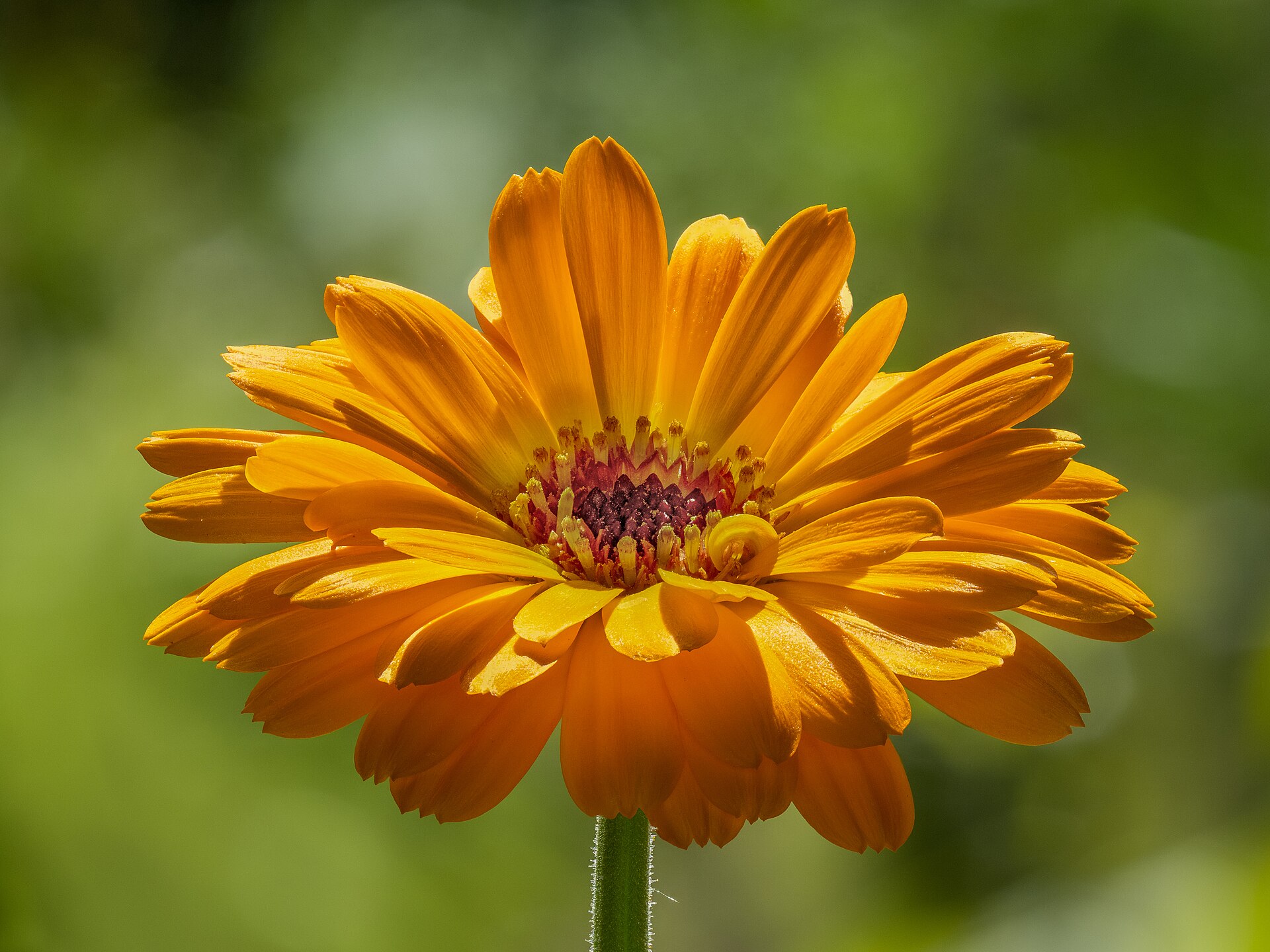
Calendula is an easy, cheerful annual with bright orange or yellow, daisy-like flowers [1]. It comes from southern Europe and the eastern Mediterranean. It is not native to North America, but it is widely grown in gardens here and sometimes escapes into the wild in cool, temperate areas [1]. The petals are edible, and the flowers have long been used for food coloring, dye, and folk medicine [1][2].
Its best-supported role is on the skin. European regulators accept calendula flower as a traditional herbal medicine for minor skin inflammation (such as sunburn), to help minor wounds heal, and for minor mouth or throat inflammation. That acceptance rests on long use, not on strong clinical trials [4][5]. Human studies are few, small, and give mixed results [4][8].
Quick facts
Specimen · Asteraceae
Botanical name
Calendula officinalis L.
Family
Asteraceae (daisy / aster family)
Other names
pot marigold, marigold, common marigold, garden marigold, English marigold, Scotch marigold, Mary bud, gold bloom
❦
Names
Common names: calendula, pot marigold, marigold, common marigold, garden marigold, English or Scotch marigold, Mary bud, gold bloom [1][2][3]
Family: Asteraceae, the daisy family [1][2]. Chrysanthemums, daisies, and garden marigolds are in the same family, and people allergic to them can react to calendula [6].
A name that causes confusion: calendula is often called "pot marigold," but it is not one of the "true" marigolds sold as bedding plants. Those are Tagetes species, such as French and African marigold [1][7]. See Look-alikes to avoid.
❦
Traditional uses
This section describes how people have used calendula historically. It does not show that these uses work. See the next section for the evidence.
Skin and wounds: the EU's traditional-use monograph lists minor skin inflammation such as sunburn and help with healing minor wounds [4][5].
Mouth and throat: the same monograph lists rinses and gargles for minor mouth or throat inflammation [4][5].
Sore, cracked nipples during breastfeeding: calendula creams and ointments have been used for this, including homeopathic products [6].
Digestion and cramps: NC State Extension notes medicinal use for stomach problems and muscle spasms [2].
Food and color: the petals have been used as a garnish and seasoning, in soups, custards, rice, and cookies, and as a traditional yellow coloring for cheese [1][2].
Dye and cosmetics: the flowers have been used to dye fabrics, foods, and cosmetics [1][2].
❦
What the evidence says
Bottom line: the evidence is weak and mixed. There are a few human trials, mostly on skin. Some look promising and others found no benefit. The European Medicines Agency reviewed clinical studies on leg ulcers, burns, and skin inflammation but "firm conclusions could not be drawn" because of problems with how the studies were designed. It approves calendula only for traditional use [4]. EU regulators are currently collecting new data for a periodic review of the monograph [4].
What has been studied:
Use
What was found
Strength
Skin reactions from breast-cancer radiation
In a French trial of 254 breast-cancer patients, a calendula ointment was compared with trolamine (another skin cream). Moderate-to-severe skin reactions happened in 41% of the calendula group vs 63% of the trolamine group [9]. A later Swedish trial of 420 patients found no difference between a calendula cream and a standard aqueous (moisturizing) cream [10].
Mixed. Two trials disagree, so the benefit is not established.
Wound healing (cuts, ulcers, burns)
A 2019 systematic review found 14 studies (7 in animals, 7 in people). Results in animals were fairly consistent. In people they were mixed: two studies on venous leg ulcers showed smaller ulcers, while trials on diabetic leg ulcers and on burns showed no benefit [8].
Weak. Small studies with mixed results. Larger, better trials are needed [8].
Sore or cracked nipples while breastfeeding
LactMed says little high-quality evidence supports this use. One study of "modest quality" used a calendula-plus-echinacea product, and another used a two-herb cream without a comparison group [6].
Very weak. Not possible to judge calendula on its own.
Lab and animal studies
Animal studies suggest calendula extract speeds up the inflammation stage of healing and the growth of new tissue [8].
Preliminary. Animal results often don't carry over to people.
What we can't say: there is no good evidence that calendula taken by mouth helps stomach problems, cramps, or other internal conditions. There is not enough evidence that it reliably prevents radiation skin reactions [8][10]. The EU traditional-use approval covers only use on the skin and in the mouth or throat, not swallowing it as medicine [4][5].
❦
How it’s used / prepared
This is general, traditional information, not a recommendation or a dose for you. Talk with a health professional before using calendula for a health purpose.
Parts used: the dried flowers (flower heads or petals) [4][5].
Compress (soaked dressing): the EU traditional-use monograph describes an infusion made by pouring hot water over 1–2 grams of dried flower in 150 ml (about ⅔ cup) of water. The still-warm infusion is used to soak a dressing that is left on for 30–60 minutes [5].
Mouth rinse or gargle: the monograph describes the same kind of infusion used for rinsing and gargling, for people 12 and older [5].
Creams, ointments, and oils: the monograph covers ointments with about 2–20% calendula, depending on the preparation, as well as oil-based extracts (for example, flowers soaked in olive oil). It describes a thin layer applied to the affected area 2–4 times a day [5].
Tinctures: alcohol-based tinctures are diluted before use on the skin, according to the monograph [5].
As food: the petals are edible and taste slightly bitter, tangy, and peppery. They add color to salads, soups, rice, custards, and baked goods [1][2]. Calendula is on the U.S. FDA's list of spices and natural seasonings "generally recognized as safe" [11].
When to stop and get help: in the EU guidance, see a doctor if symptoms last more than 1 week, get worse, or show signs of a skin infection [4][5].
Buying vs. growing: buy dried flowers or products labeled Calendula officinalis. If you grow your own, harvest fully opened flowers after the dew has dried, and dry them out of direct sunlight [1].
❦
How to identify
Calendula is a garden and store herb, not something you need to forage. Here is how to recognize the plant and the product.
Plant: a bushy annual about 1–2 feet tall and wide [2]. The stems are angular, branched, and covered in fine hairs [1].
Leaves: simple (not divided), alternate, lance-shaped to oblong, up to about 6 inches long. They are hairy, sticky, and aromatic, though modern varieties are often less sticky [1][2].
Flowers: daisy-like heads about 2–4 inches across, usually bright orange or yellow (some white or bicolored), often with a darker center. There are single and double forms [1][2].
Seeds: unusual curved, C-shaped or "nail-like" seeds that form a ring after the petals drop [1].
Season: a cool-season plant. It flowers over a long period but may slow down in hot summer weather and pick up again when it cools [1][2].
Dried product: sold as dried whole flower heads or loose petals. Look for the botanical name Calendula officinalis on the label so you don't get Tagetes marigold instead [1][7].
❦
Look-alikes to avoid
When in doubt, don't.
If you are not sure which "marigold" you have, don't eat it or put it on broken skin.
Calendula has no deadly look-alikes. The main risk is mixing it up with other plants called "marigold" because of the shared common name.
French and African marigolds (Tagetes patula and Tagetes erecta): mildly irritating; not a substitute for calendula
What they are: the common bedding-plant marigolds. They are in the same daisy family but a different genus, native to Mexico and Guatemala [7][13][14].
Leaves: divided into many small leaflets (compound, fern-like) and not hairy[13]. Calendula leaves are simple, undivided, and hairy [1][2].
Smell: the leaves and flowers have a strong scent that is used to discourage garden insects [13].
Flowers: French marigold heads are about 1–2 inches wide and come in yellows, oranges, and reds, often doubled [13]. African marigold is taller (1–4 feet) with large double flowers 2–6 inches wide [14].
Toxicity: NC State Extension lists Tagetes as low-severity poisonous. Sap on broken skin plus sunlight can cause redness, burning pain, and blisters, and the flower scent can irritate the nose and eyes [13][14].
Marsh marigold (Caltha palustris): despite the name, it is in a different plant family (Ranunculaceae) and is not related to or similar to calendula [7]. Don't use it in place of calendula.
Daisy-family (Asteraceae) allergy: don't use calendula if you are allergic to it or to related plants [4][5]. LactMed notes rare allergic reactions, including cross-reactions with chrysanthemums, daisies, and marigolds [6].
Skin reactions: skin sensitization (developing an allergy through skin contact) has been reported, though how often is not known [4][5]. In one study of 443 people who were patch-tested for skin allergies, about 2% reacted to calendula [15]. Test a small patch of skin first, and stop if a rash develops.
Pregnancy: safety as a medicine hasn't been established, so EU regulators don't recommend medicinal use during pregnancy [5]. The FDA lists calendula as safe as a seasoning [11], but that covers food amounts, not medicinal use.
Breastfeeding: EU regulators don't recommend medicinal use because there isn't enough data [5]. LactMed has an entry. It says there is no information on taking calendula by mouth while breastfeeding, and that topical products have been used on sore nipples, with little high-quality evidence behind them [6].
Children: the EU guidance does not recommend skin use under age 6 or mouth/throat use under age 12, because of a lack of data [4][5].
Medication interactions: none reported in the EU monograph [5]. We did not find reliable evidence for specific calendula–drug interactions, so we don't list any. If you take prescription medicine, ask your pharmacist before using any herbal product by mouth.
Pets: the ASPCA lists pot marigold as non-toxic to dogs and cats [3].
Look-alike risk:Tagetes marigolds can irritate skin, especially in sunlight [13]. Check the botanical name.
Not medical advice
This page is for general education only. It is not medical advice and doesn't replace a doctor, pharmacist, or other qualified professional. Herbs can cause allergic reactions and interact with medicines. Check with a health professional before using any herb, especially if you are pregnant or breastfeeding, giving it to a child, taking medication, or managing a health condition. Never eat or use a wild plant unless an expert has confirmed what it is. For a suspected poisoning in the U.S., call Poison Help at 1-800-222-1222 [12]. In Canada, call 1-844-POISON-X (1-844-764-7669), or the Centre antipoison du Québec at 1-800-463-5060 if you are in Québec [16].
Givol O, Kornhaber R, Visentin D, et al. A systematic review of Calendula officinalis extract for wound healing. Wound Repair Regen. 2019. https://pubmed.ncbi.nlm.nih.gov/31145533/
Pommier P, Gomez F, Sunyach MP, et al. Phase III randomized trial of Calendula officinalis compared with trolamine for the prevention of acute dermatitis during irradiation for breast cancer. J Clin Oncol. 2004. https://pubmed.ncbi.nlm.nih.gov/15084618/
Sharp L, Finnilä K, Johansson H, et al. No differences between Calendula cream and aqueous cream in the prevention of acute radiation skin reactions: results from a randomised blinded trial. Eur J Oncol Nurs. 2013. https://pubmed.ncbi.nlm.nih.gov/23245940/
Reider N, Komericki P, Hausen BM, et al. The seamy side of natural medicines: contact sensitization to arnica (Arnica montana L.) and marigold (Calendula officinalis L.). Contact Dermatitis. 2001. https://pubmed.ncbi.nlm.nih.gov/11722485/
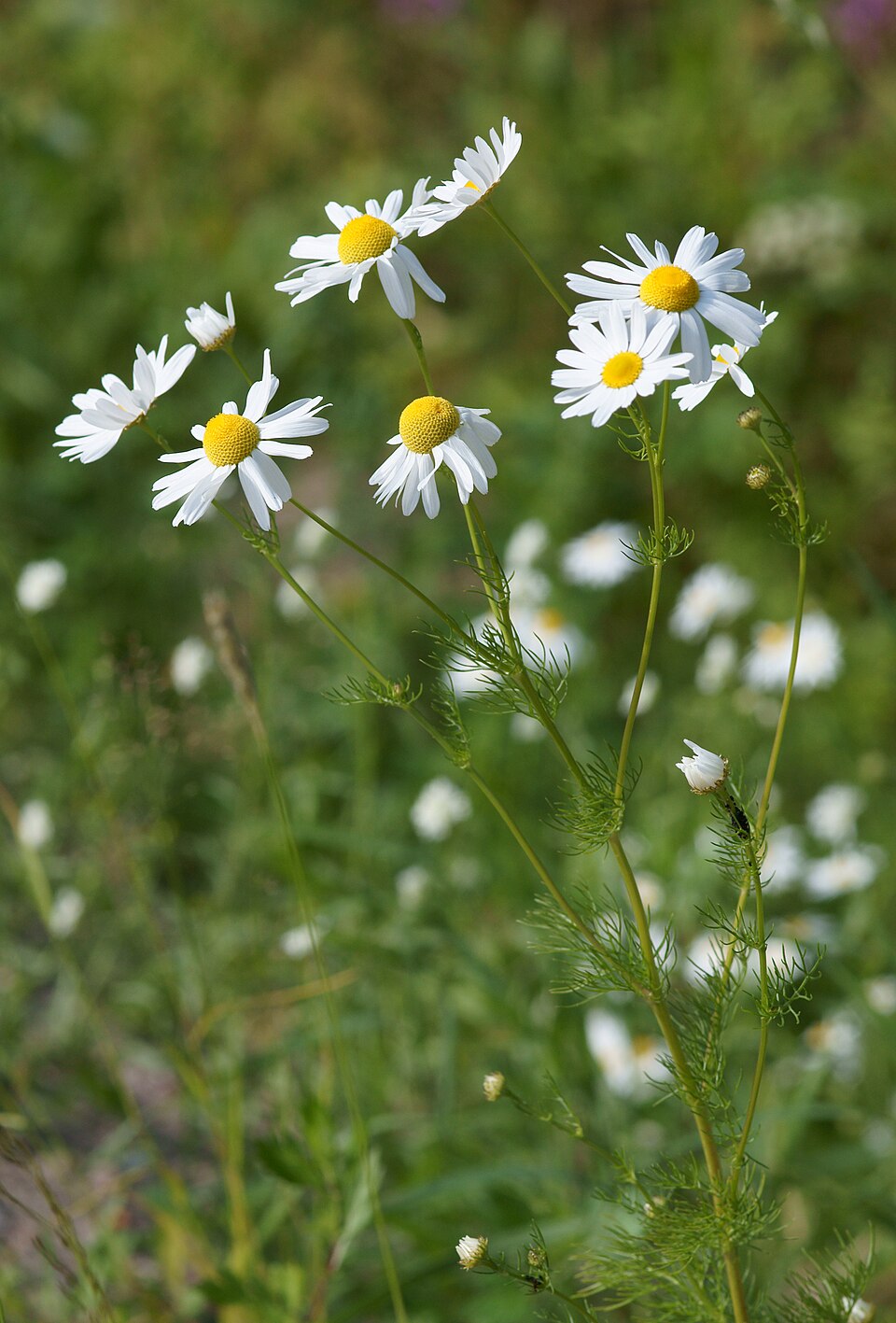
German chamomile is a small, sweet-smelling annual with feathery leaves and little daisy-like flowers that have white petals and a domed yellow center.