Elderberries are the small, dark purple-black berries of the elder, a large shrub or small tree [2][4]. American elderberry is native to North, Central, and South America. It grows wild along creeks, marshes, moist forest edges, and disturbed ground [2][5]. European black elder is native to Europe and has naturalized in the United States [1][3]. Both are grown in gardens for their flowers and fruit [2][3].
Elderberry syrup is one of the most popular cold-and-flu remedies. A small number of studies suggest elderberry may shorten or ease colds and flu, but the evidence is preliminary and uncertain [4][6]. Elderberry has also been promoted for COVID-19, and there is no good evidence for that use [4]. Unlike most herbs on Verdant Almanac, the plant itself is toxic if prepared the wrong way.
Quick facts
Specimen · Viburnaceae
Botanical name
Sambucus canadensis L. (American elder); Sambucus nigra L. (European or black elder)
Family
Viburnaceae (viburnum family; older references use Caprifoliaceae, the honeysuckle family)
Other names
elder, American elder, European elder, black elder, common elder, sweet elder, Sambucus
❦
Names
Common names: elderberry, elder, American elder (S. canadensis), European or black elder (S. nigra), common elder, and sweet elder [1].
Botanical names:Sambucus canadensis L., American elderberry [2], and Sambucus nigra L., European or black elder [3]. This page covers both. Drugs.com covers them together in one monograph [1].
Family: NC State Extension places elder in the viburnum family (Viburnaceae) [2]. Older references list it in the honeysuckle family (Caprifoliaceae) [1].
Where the name comes from:nigra means "black," after the color of the fruit [3]. Canadensis means "of Canada" [2].
❦
Traditional uses
This section describes how people have used elderberry historically. It does not show that these uses work. See the next section for the evidence.
Colds and flu: elderberry has been used in folk medicine for colds and flu [4]. Indigenous peoples of North America used elderberries medicinally for centuries [5].
Ancient use: Mississippi State University Extension notes that the ancient Greek physician Hippocrates made remedies from European elder [5].
Flowers: in folk medicine, elder flowers have been used as a diuretic, a laxative, and an astringent [1]. European regulators accept elder flower tea as a traditional remedy for the early symptoms of a common cold [12].
Food and drink: the cooked berries go into pies, jellies, jams, syrups, and wine. The flowers are used for wine, cordials, and desserts [2][3][5].
Other uses: the twigs and fruit have been used to dye baskets, and the stems were made into flutes and whistles [2].
❦
What the evidence says
Bottom line: the evidence is limited and uncertain. There are only a few small trials, mostly of commercial European elderberry extracts [5][6]. Elderberry may shorten colds and flu, but researchers rate the certainty of that evidence as low [6].
Use
What was found
Strength
Flu
Small trials found that elderberry extract, started within 48 hours of symptoms, shortened flu compared with placebo [1]. A 2021 systematic review concluded that elderberry may shorten flu, but the evidence is uncertain [6].
Preliminary. The trials are small.
Colds
The 2021 review found elderberry may not lower your chance of catching a cold. It may shorten colds and make them milder, but that evidence is uncertain [6]. In a trial of 312 air travelers, elderberry didn't significantly reduce the number of colds. But the elderberry group had about half as many total cold days, and milder symptoms [13].
Preliminary
Upper respiratory symptoms overall
A 2019 meta-analysis pooled 180 people and reported a large reduction in symptoms [14]. It is small, and a later, more cautious review rated the evidence as uncertain [6].
Small; mixed confidence
"Overstimulating" the immune system
The 2021 review found no evidence that elderberry overstimulates the immune system (a COVID-era concern) [6].
Limited data
COVID-19
No good evidence. The FDA and FTC have acted against companies that made unproven COVID-19 claims for elderberry [4].
No evidence
Diabetes, cholesterol, weight
Mostly lab and animal studies. Human trials are lacking or found no meaningful effect [1].
No good human evidence
What regulators concluded: European regulators could not write a monograph for elderberry fruit, because the information on long-standing use and doses was incomplete [15]. They did accept elder flower tea as a traditional remedy for early cold symptoms, while noting the "lack of clinical studies" [12].
What we can't say: that elderberry prevents colds or flu, treats or prevents COVID-19, or can replace a flu vaccine or antiviral medicine prescribed by your doctor [4][6]. Most research used European elder, so it's not certain the results apply to American elder, although Mississippi State Extension believes they likely do [5].
❦
How it’s used / prepared
This is general, traditional information, not a recommendation or a dose for you. Talk with a health professional before using elderberry for a health purpose.
Parts used: the ripe, cooked berries and the flowers [2][3][16]. Not the leaves, stems, bark, roots, or unripe berries [2][4].
Cook the berries: Mississippi State Extension says elderberries "must be cooked at a high temperature or fermented first." Its syrup recipe removes all stems, then simmers the berries for 30–45 minutes [5].
Don't press berries with leaves or stems. That's how the 1983 California poisoning happened [8].
Syrups and extracts: most products sold in stores are made from European elder [5]. U.S. supplements don't need FDA approval before they're sold, and the actual contents can differ from the label [7].
Elder flower tea: the EU traditional-use monograph describes an infusion of dried elder flowers for early cold symptoms, for people 12 and older. It says to see a doctor if symptoms last more than a week [12][16].
Food: cooked berries in pies, jams, jellies, and wine; flowers in cordials and desserts [2][3][5].
Buying vs. foraging: buying dried berries or a commercial product avoids foraging altogether [5]. If you forage, learn the plant with an expert first, and avoid roadsides and areas that may be sprayed with herbicides or pesticides [17].
When to stop and get help: if someone has eaten raw berries, leaves, or stems and has nausea, vomiting, or dizziness, call Poison Help (see below) [8][18].
❦
How to identify
Learn elderberry with an experienced person or your local extension office before you harvest it. Mississippi State Extension says to be "100 percent certain" of a wild plant's identity before eating it [17]. Check every feature below.
Growth form: a woody, multi-stemmed shrub or small tree. American elder is 5–12 feet tall and usually wider than tall [2]. European black elder is 10–20 feet tall [3]. Both spread by root suckers and form thickets [2][3][5].
Bark and stems: young branches are light grayish-brown with small raised pores (lenticels), and the pith inside is white. Older stems are gray and warty [2][5].
Leaves: compound, with 5–11 leaflets (usually 7) arranged in pairs plus one at the tip. Leaflets are 2–6 inches long and sharply toothed [2]. European elder leaves have an unpleasant smell when crushed [3].
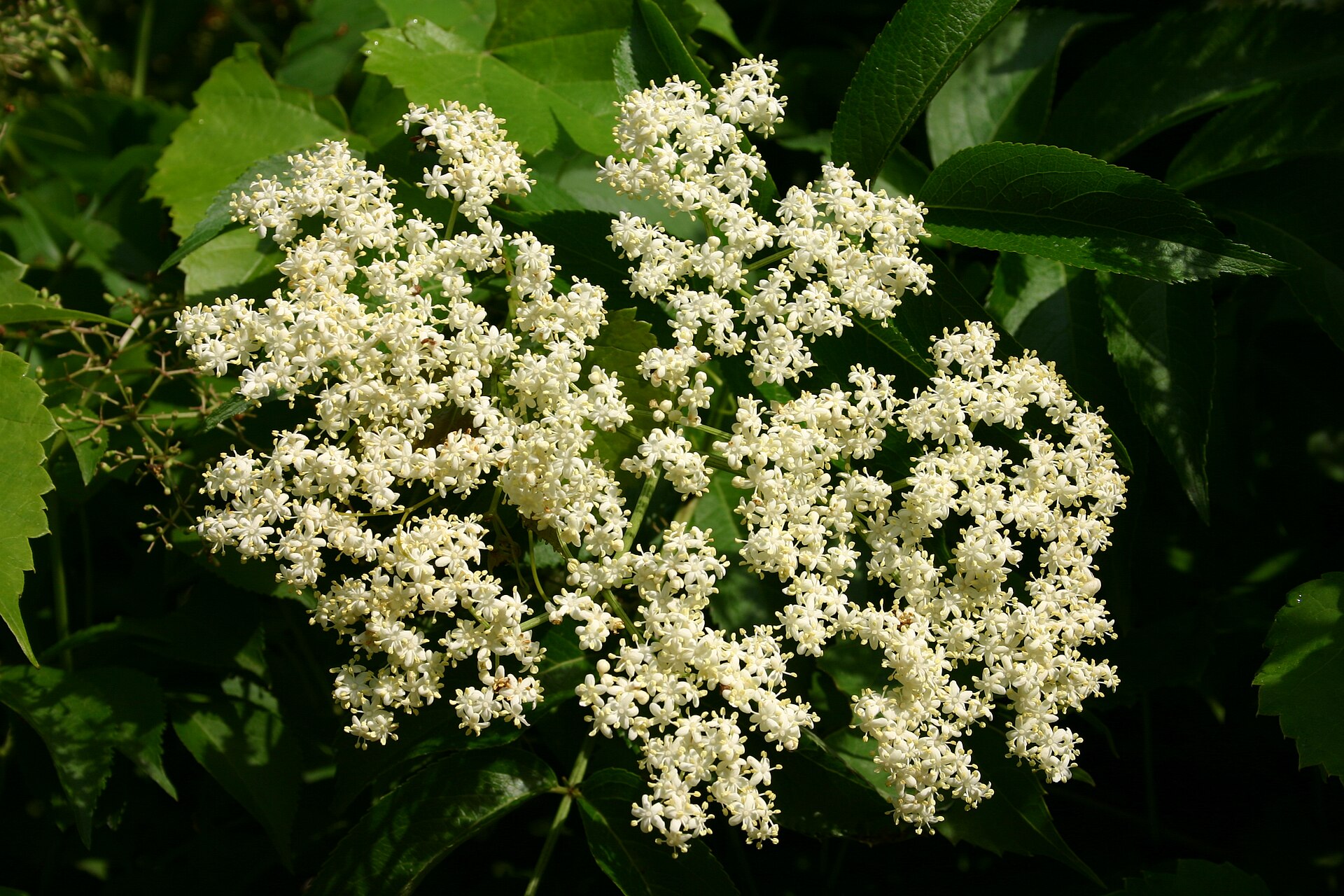
Flowers: many tiny (¼-inch), fragrant, creamy-white flowers in flat-topped to rounded clusters 4–10 inches across. American elder blooms around June [2]. European elder flowers smell musky [3].
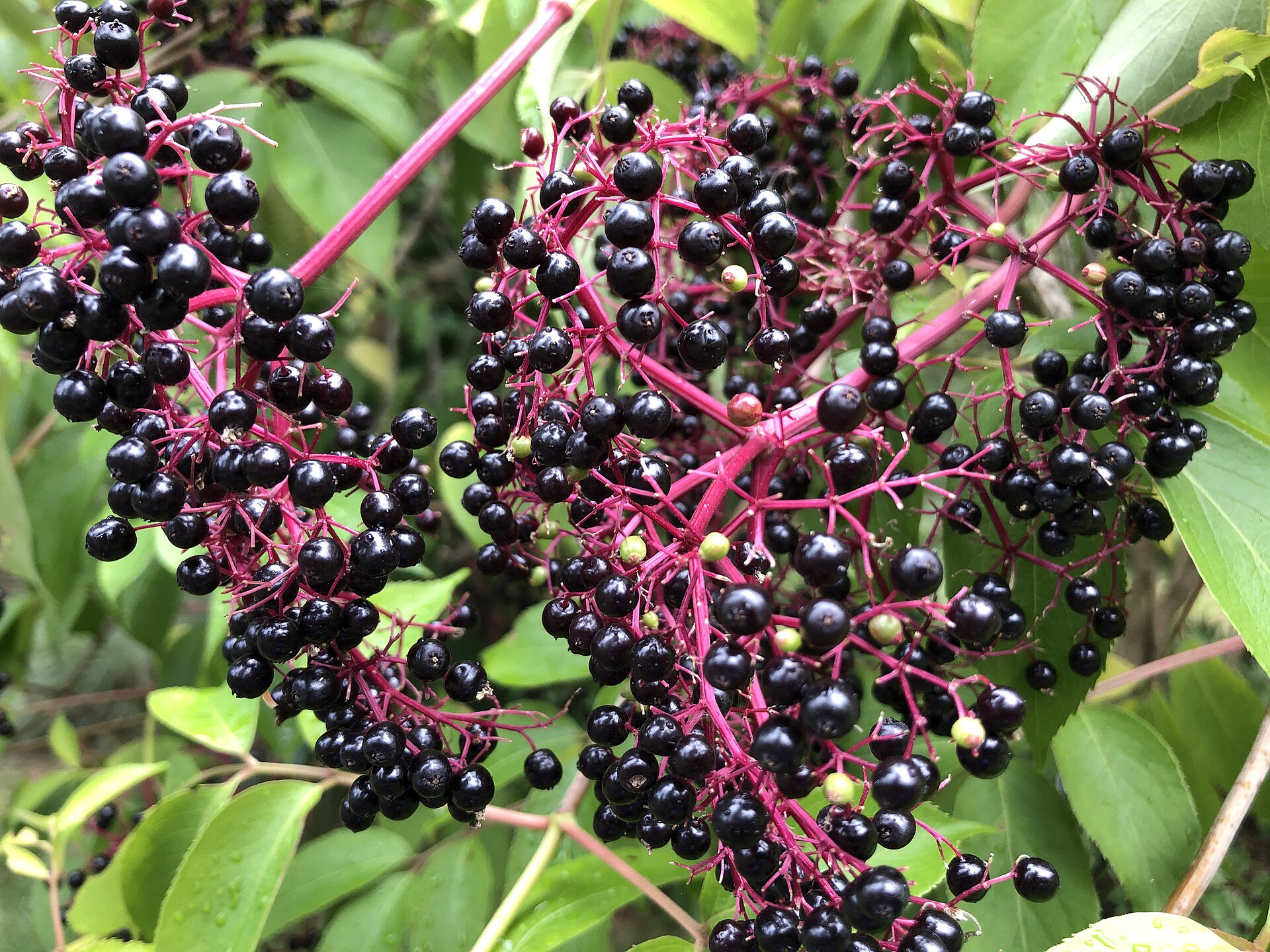
Fruit: clusters of round, purple-black berries about ¼ inch across, each with 3–5 small stones. They hang in large drooping clusters and ripen from late summer to fall [2][5].
Habitat: streambanks, marshes, moist forest edges, and disturbed areas, in sun to part shade [2][5].
Range: American elder is native to North, Central, and South America [2].
A broad, flat-topped cluster of tiny cream-white American elder flowers above dark green compound leavesPhoto: SB_Johnny, CC BY-SA 3.0, via Wikimedia Commons
❦
Look-alikes to avoid
When in doubt, don't.
If any feature doesn't match, or you can't check all of them, leave the plant alone.
The Missouri Department of Conservation calls it "the most toxic plant in North America." All parts are deadly, and the roots are the most toxic [19][20].
In flower, its white, umbrella-like clusters look very similar to elderberry flowers [9].
The key difference is the stem. Water hemlock is a non-woody plant with smooth, hairless stems, while elder is a woody shrub [9]. Water hemlock stems are hollow, often purple-striped or mottled, and divided inside by cross-walls at the joints [19].
Leaves: 2–3 times divided. The side veins of each leaflet end in the notches between the teeth, not at the tips [19][20].
Habitat: wet places such as ditches, streambanks, pond edges, and wet meadows, often the same places elder grows [19][20].
Symptoms include seizures, muscle spasms, and breathing problems, and poisoning may be fatal [19].
Poison hemlock and wild carrot (Queen Anne's lace)
These also have white, umbrella-like flower clusters that can look like elder flowers [9]. Their leaves are much more finely divided and fern-like. Poison hemlock has smooth stems with purple spots, and Queen Anne's lace has green, hairy stems [9][20]. Neither is woody. Poison hemlock is highly toxic [20].
Pokeweed (Phytolacca americana): poisonous
Every part of the plant is poisonous to people and pets [10][11]. Mississippi State Extension says the roots and berries are highly toxic and should never be eaten [17].
Growth form: a large non-woody perennial, 4–10 feet tall, with smooth, stout reddish-purple stems[5][10][11].
Leaves:simple (not divided into leaflets), up to 12 inches long, with an unpleasant smell when crushed [10][11].
Fruit: dark purple berries in long, drooping clusters along a central stalk. Each berry has about 10 seeds [5][11]. Elderberries grow in broad, branched clusters [2].
NC State Extension recommends wearing gloves when handling it [10].
Cow parsnip (Heracleum maximum): skin hazard
NC State Extension lists it as a plant often confused with American elderberry [21].
Growth form: a non-woody carrot-family plant, 4–15 feet tall, with flat white flower clusters 6–8 inches across [21].
Leaves and stem: very large leaves split into 3 lobed leaflets. The stem is hollow, grooved, and blotched with purple, with white woolly hairs [21].
Danger: its sap, followed by sunlight, can cause sunburn-like skin reactions and eye irritation [21].
Raw, unripe, and green parts: raw or unripe berries, and the leaves, stems, and other parts of the plant, contain cyanide-producing substances. They can cause nausea, vomiting, and severe diarrhea. Large amounts can cause serious illness [4]. Unripe fruit is much more toxic than ripe fruit, and cooking helps inactivate the toxin [2]. LactMed notes that cooked berries don't carry this risk [7].
A real outbreak: in 1983, juice made from wild elderberries crushed with their leaves and branches sickened 11 people in California. Eight were flown to a hospital with nausea, vomiting, cramps, weakness, dizziness, and numbness. One was hospitalized, and all recovered [8].
Children: Drugs.com notes reports of children poisoned after using elder stems as peashooters [1]. EU guidance does not recommend elder flower medicines under age 12 [16].
Medication interactions: none are well documented. Drugs.com lists theoretical interactions with diabetes medicines (insulin), blood pressure medicines, some chemotherapy drugs, laxatives, and theophylline [1]. EU regulators found no reported interactions for elder flower [16]. NCCIH advises talking with your health care provider if you take any medicine [4].
Allergy: allergic reactions are rare, but they have been recorded [1][7].
Other reports: there is one case report of acute pancreatitis after a homeopathic elderberry product [1]. Long-term safety studies are lacking [1].
Pregnancy: little is known about safety in pregnancy [4]. EU guidance does not recommend elder flower medicines during pregnancy [16].
Breastfeeding: there are no data on elderberry in breast milk or on its safety for nursing mothers or infants. LactMed says no recommendations can be made on medicinal doses [7]. EU guidance does not recommend elder flower medicines while breastfeeding [16].
Pets and livestock: NC State Extension lists American elder as a problem plant for horses [2].
This page is for general education only. It is not medical advice and doesn't replace a doctor, pharmacist, or other qualified professional. Herbs can cause allergic reactions and interact with medicines. Check with a health professional before using any herb, especially if you are pregnant or breastfeeding, giving it to a child, taking medication, or managing a health condition. Never eat or use a wild plant unless an expert has confirmed what it is. For a suspected poisoning in the U.S., call Poison Help at 1-800-222-1222 [18]. In Canada, call 1-844-POISON-X (1-844-764-7669), or the Centre antipoison du Québec at 1-800-463-5060 if you are in Québec [22].
Wieland LS, Piechotta V, Feinberg T, et al. Elderberry for prevention and treatment of viral respiratory illnesses: a systematic review. BMC Complement Med Ther. 2021. https://pubmed.ncbi.nlm.nih.gov/33827515/