Ginger is a tropical plant native to the warm parts of Asia. Today it's also grown in parts of South America, Africa, and the Middle East [1][2]. In North America, most people know it as the knobby, tan, spicy "root" in the grocery store. In cold climates you can still grow it in a pot or as an annual [2].
Compared with many herbs, ginger has a fair amount of research in people, especially for nausea and vomiting in pregnancy. Even there, the research quality is low to mixed, and many studies used supplements rather than food ginger [1][5][6].
Family: Zingiberaceae, the ginger family. Despite the name, Canadian "wild ginger" (Asarum canadense) is unrelated and belongs to the pipevine family [2][4]. See Look-alikes to avoid.
Part used: the "root" is really a rhizome, an underground stem [1].
❦
Traditional uses
This section describes how people have used ginger historically. It does not show that these uses work. See the next section for the evidence.
Folk medicine since ancient times: ginger was traditionally used for asthma, flu, indigestion, and stomach or gut discomfort [1].
Digestion and appetite: European regulators recognize ginger as a traditional remedy for mild spasmodic stomach complaints (bloating and gas) and temporary loss of appetite [3][7].
Colds, aches, and travel sickness: the EU monograph also lists traditional use for cold symptoms, minor joint pain, and travel sickness [3][7].
Breastfeeding: ginger is reportedly used to increase milk supply in Türkiye, Indonesia, and parts of Asia. In some other cultures it's thought to decrease milk supply [8].
Food: the rhizome, ginger root, and young sprouts are all eaten [2].
❦
What the evidence says
Bottom line: ginger is one of the better-studied herbs, but the evidence is still modest and not always consistent. NCCIH notes there have been many studies in people, "but some of them have not been of high quality," and most tested supplements rather than food [1].
Use
What was found
Strength
Nausea in pregnancy
A 2014 meta-analysis of 12 trials (1,278 pregnant women) found ginger improved nausea compared with placebo, but it did not significantly reduce vomiting episodes [6]. A Cochrane review found ginger "may be helpful," but the evidence was "limited and not consistent," and there was no high-quality evidence for any treatment [5]. NCCIH says research shows ginger may be helpful here [1].
The best-supported use, but low-quality evidence [5][6]. Talk to your prenatal care provider first.
Menstrual cramps
A 2015 meta-analysis of 4 placebo-controlled trials found ginger powder reduced menstrual pain during the first 3–4 days of the cycle [9]. NCCIH says supplements "might be helpful" [1].
Small trials, suggestive
Motion sickness
NCCIH says most studies haven't shown ginger helps [1]. EU regulators, however, accept a specific ginger powder for preventing motion sickness as "well-established use," based on clinical studies [3].
Conflicting. Sources disagree.
Chemotherapy nausea and post-surgery nausea
It's uncertain whether ginger helps alongside standard treatment [1].
Uncertain
Knee osteoarthritis
Supplements might help symptoms, but much of the research is poor quality. Ginger applied to the skin hasn't been shown to help [1].
Weak
Milk supply while breastfeeding
A review of 5 studies found weak evidence that ginger may increase milk supply after vaginal birth, but not after cesarean birth [8].
Weak
What we can't say: that ginger reliably prevents motion sickness (the sources disagree), that it helps nausea after surgery or chemotherapy, or that topical ginger helps arthritis [1][3].
❦
How it’s used / prepared
This is general, traditional information, not a recommendation or a dose for you. Talk with a health professional before using ginger for a health purpose.
Food: fresh, dried, or ground ginger in cooking and drinks. It's generally recognized as safe (GRAS) as a food flavoring by the FDA [8].
Powder and capsules: the EU monograph lists specific measured doses of powdered ginger for adults [7]. Most clinical studies used supplements, not food [1].
Tincture: the monograph also describes alcohol-based tinctures [7].
Topical: ginger is used in some topical herbal mixtures [8]. NCCIH says topical ginger products may be safe, though they haven't been shown to help knee arthritis [1].
When to stop and get help: EU guidance says to see a doctor if digestive or appetite symptoms last more than 2 weeks, cold symptoms more than 1 week, or joint pain more than 4 weeks. Joint pain with swelling, redness, or fever should always be checked by a doctor [3][7].
❦
How to identify
Ginger is a store and container-garden herb. You won't find true ginger growing wild in most of North America.
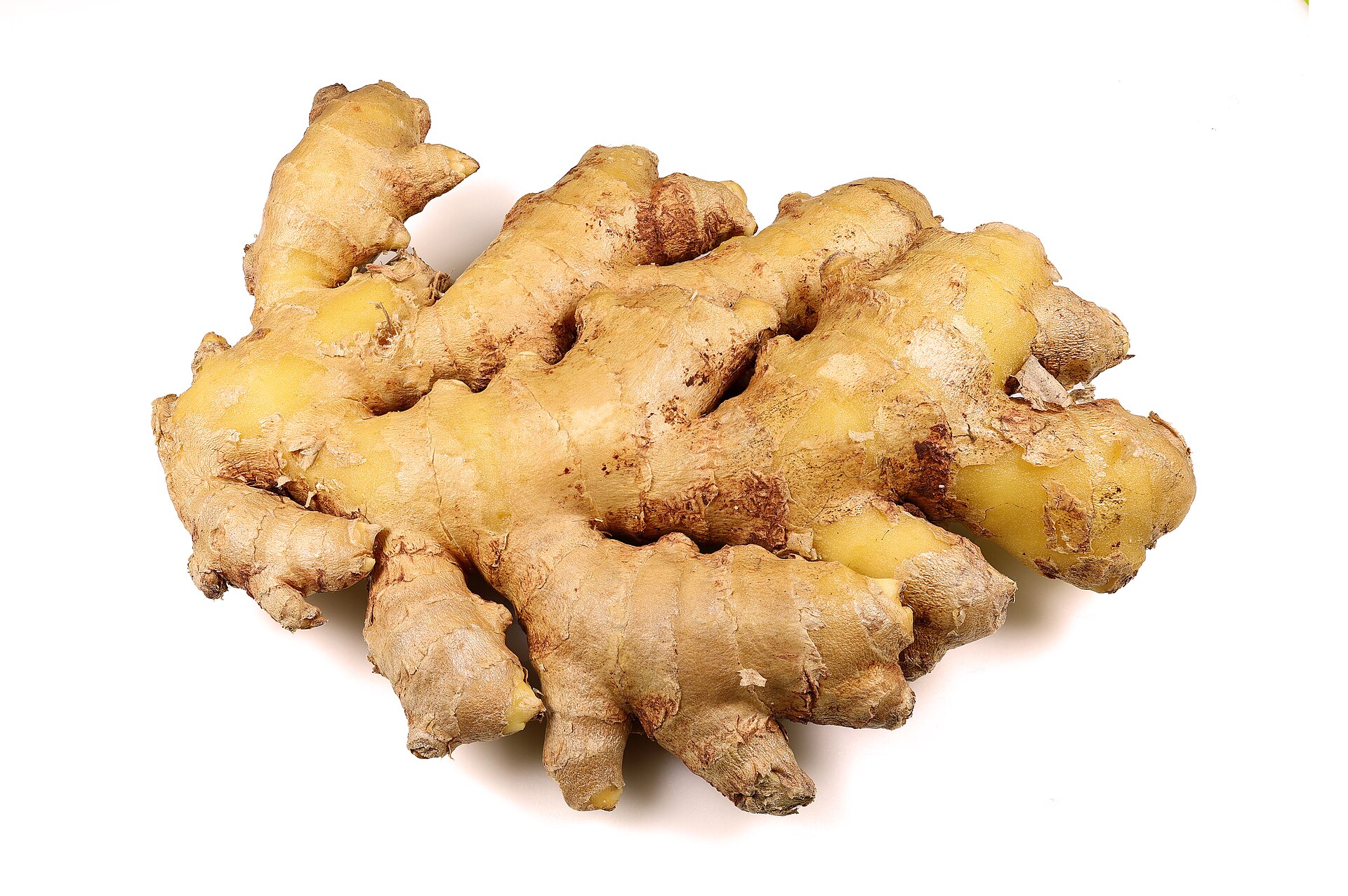
The rhizome (what you buy): brown to golden with a thin, corky skin. The inside is pale yellow with a spicy scent. Young rhizomes are juicy and mild, while older ones are drier, more fibrous, and hotter [2].
Leaves and stems: grown as a plant, ginger sends up one or two leafy stems about 2–4 feet tall [2].
Flowers: cone-shaped spikes with green or yellow bracts, on a separate leafless stem. A new plant can take a couple of years to flower, and container plants rarely bloom [2].
Growing range: tropical, hardy outdoors only in about USDA zones 9–12. Elsewhere, grow it in a pot and bring it indoors before temperatures drop below 50 °F [2].
Buying tips: fresh ginger should look firm and smell spicy. For supplements, check the label for Zingiber officinale. U.S. supplements are not FDA-approved before sale, and contents can differ from the label [8].
❦
Look-alikes to avoid
When in doubt, don't.
If any feature doesn't match, or you can't check all of them, leave the plant alone.
Store-bought ginger has no dangerous look-alike. The risk is a different plant called "wild ginger" that grows in North American woods.
Canadian wild ginger (Asarum canadense): do not eat
A low woodland plant native to eastern North America, in a completely different family (pipevine, Aristolochiaceae) [4].
Leaves: a pair of heart-shaped, dull gray-green, finely hairy leaves 3–6 inches long, growing from the ground. The whole plant is only 6–12 inches tall [4].
Flowers: a single small brown-purple, bell-shaped flower hidden under the leaves in April–May [4].
Smell: the root has a ginger-like scent, and early Americans used it as a ginger substitute [4].
Toxicity: it contains aristolochic acid, which damages the kidneys and causes cancer. NC State Extension says: "Do not consume any part of this plant" [4].
NC State Extension lists it as a plant often confused with true ginger [2].
Common side effects: belly discomfort, heartburn, diarrhea, and mouth or throat irritation when taken by mouth [1]. Bad taste, headache, dry mouth, and nausea are reported occasionally [8]. EU regulators also list skin allergy [3].
Allergy: don't use ginger if you're allergic to it [3].
Blood thinners: LactMed says ginger can increase bleeding risk when taken with warfarin[8]. EU regulators found no interactions described in the literature [3][7]. Because sources differ, talk to your doctor or pharmacist before using ginger supplements if you take any blood thinner.
Pregnancy: NCCIH says ginger supplements in pregnancy may be safe, but talk with your health care provider first [1]. A meta-analysis found no significant increase in miscarriage or side effects compared with placebo [6]. EU regulators, as a precaution, prefer to avoid medicinal ginger in pregnancy, even though data on 300–1,000 pregnancy outcomes showed no birth defects or harm to the baby [7]. This is a real difference between sources. Decide with your prenatal care provider.
Breastfeeding: very limited data. Ginger is GRAS as a food flavoring, including during breastfeeding [8]. EU guidance does not recommend medicinal use while breastfeeding because there isn't enough data [7].
Children: EU guidance does not recommend medicinal ginger under 18 for most uses because of a lack of data. Its traditional motion-sickness product is not for children under 6 [3][7].
Not medical advice
This page is for general education only. It is not medical advice and doesn't replace a doctor, pharmacist, or other qualified professional. Herbs can cause allergic reactions and interact with medicines. Check with a health professional before using any herb, especially if you are pregnant or breastfeeding, giving it to a child, taking medication, or managing a health condition. Never eat or use a wild plant unless an expert has confirmed what it is. For a suspected poisoning in the U.S., call Poison Help at 1-800-222-1222 [10]. In Canada, call 1-844-POISON-X (1-844-764-7669), or the Centre antipoison du Québec at 1-800-463-5060 if you are in Québec [11].
Viljoen E, Visser J, et al. A systematic review and meta-analysis of the effect and safety of ginger in the treatment of pregnancy-associated nausea and vomiting. Nutr J. 2014. https://pubmed.ncbi.nlm.nih.gov/24642205/
Daily JW, Zhang X, et al. Efficacy of ginger for alleviating the symptoms of primary dysmenorrhea: a systematic review and meta-analysis of randomized clinical trials. Pain Med. 2015. https://pubmed.ncbi.nlm.nih.gov/26177393/