Also called common thyme, garden thyme, German thyme
Safety noteLast reviewed
Photo: Javier martin, public domain, via Wikimedia Commons
Overview
Thyme is a small, woody, evergreen herb with tiny, very fragrant leaves. It is native to southwestern Europe and southeastern Italy [1]. In North America it is a garden and kitchen herb rather than a wild plant. It is grown mainly for cooking and forms a low mound 6–12 inches high [1].
Its best-supported medicinal role is for coughs. European regulators accept thyme as a traditional herbal medicine for productive ("chesty") coughs that come with a cold. That acceptance rests on long use, not on strong clinical trials [3][4]. The better trials tested thyme combined with other herbs (ivy leaf or primrose root), so they don't show what thyme does alone [5][6][7].
Quick facts
Specimen · Lamiaceae
Botanical name
Thymus vulgaris L.
Family
Lamiaceae (mint family)
Other names
common thyme, garden thyme, German thyme
❦
Names
Common names: thyme, common thyme, garden thyme, German thyme [1][2]
Botanical name:Thymus vulgaris L. [1][3]. European herbal medicines may use Thymus vulgaris, Thymus zygis, or a mix of both [3][4].
Family: Lamiaceae, the mint family [1]. People allergic to any plant in this family should avoid medicinal thyme [3].
Where the name comes from: "thyme" may come from the Greek thumos, "courage." In medieval times thyme was an emblem of bravery. It may also come from thymos, "perfume." Vulgaris is Latin for "common" [1].
❦
Traditional uses
This section describes how people have used thyme historically. It does not show that these uses work. See the next section for the evidence.
Coughs and chest colds: the EU's traditional-use monographs list thyme for productive cough with colds. Thyme oil is listed for use on the skin or in baths to ease cough and cold symptoms [4][9]. NC State Extension notes that liquid thyme preparations have been used for bronchitis [1].
Antiseptic: the leaves have been used as an antiseptic [1]. Thymol, a main compound in thyme oil, has long been used in traditional medicine as an expectorant (helps loosen mucus) and antiseptic, mainly for the upper airways [10].
Religious and ceremonial uses: thyme has been grown since ancient times for religious as well as medicinal and cooking purposes [1].
Cooking: fresh or dried leaves flavor soups, stews, sauces, meats, and fish [1].
❦
What the evidence says
Bottom line: the evidence is limited, and most of it is for thyme mixed with other herbs. The European Medicines Agency approves thyme only for traditional use, which means "there is insufficient evidence from clinical trials" but the effect is considered plausible after at least 30 years of safe use [4].
What has been studied:
Use
What was found
Strength
Productive cough (thyme alone)
The EMA reviewed a study of 60 adults that compared a thyme preparation with bromhexine, a standard cough medicine. They did about equally well, but the study was small and didn't describe the thyme product well, so "firm conclusions could not be drawn" [4].
Very weak. One small, poorly described study.
Acute bronchitis (thyme + ivy leaf syrup)
In a double-blind trial, 361 adults took a thyme-and-ivy syrup or a placebo for 11 days. Coughing fits dropped by 69% with the syrup vs 48% with placebo, and side effects were similar in both groups [5].
One good-sized trial of a combination product.
Acute bronchitis (thyme + primrose root tablets)
A similar trial in 361 adults also found faster cough relief than placebo [6].
One good-sized trial of a combination product.
Cough from colds (review)
A 2015 review of 34 trials found "strong evidence" that ivy/primrose/thyme combinations ease cough compared with placebo (4 trials) [7].
Moderate for the combinations. Says little about thyme alone. Both trials above tested products of the same brand (Bronchipret) [5][6].
Lab studies (germs)
In lab studies, thyme oil and thymol show antifungal, antiviral, antibiofilm, and other activity [10]. The EMA also considered lab data on thyme oil's antimicrobial activity [9].
Preliminary. Lab results don't show that thyme treats infections in people.
What we can't say: there is no good evidence that thyme tea or thyme oil treats infections, replaces antibiotics, or works for asthma or other serious lung disease. The cough trials used specific commercial combinations, not kitchen thyme or homemade tea [5][6][7].
❦
How it’s used / prepared
This is general, traditional information, not a recommendation or a dose for you. Talk with a health professional before using thyme for a health purpose.
Parts used: the leaves and flowers, usually dried [3][4].
Tea (infusion): the EU traditional-use monograph describes 1–2 grams of dried thyme in 150 ml (about ⅔ cup) of boiling water, up to 3–4 times a day, for people 12 and older [3].
Tinctures, syrups, and extracts: the monograph lists many liquid and dry extracts and tinctures [3]. Most are for people 12 and older, and a few are for children over 4 [3][4]. Tinctures and extracts may contain alcohol [3].
Thyme essential oil: this is much more concentrated than the herb. The EU monograph on thyme oil describes its use by mouth for adults only, and as a diluted rub on the chest and back (up to 10%) or a bath additive [8]. Thyme oil should not be applied to the face, especially near the nose of babies and children under 2, because of the risk of a dangerous throat spasm (laryngospasm)[8].
As food: thyme is a common kitchen herb [1]. The U.S. FDA lists thyme and thyme oil as "generally recognized as safe" for use as seasonings and flavorings [11][12].
When to stop and get help: in the EU guidance, see a doctor if a cough lasts more than 1 week or gets worse, or if you have shortness of breath, fever, or pus-like (yellow or green) mucus [3][4][9].
❦
How to identify
Thyme is a garden and store herb, so you don't need to forage it. Here is how to recognize it.
Plant: a bushy, low subshrub with a woody base, up to about 1 foot tall and 6–16 inches wide [1].
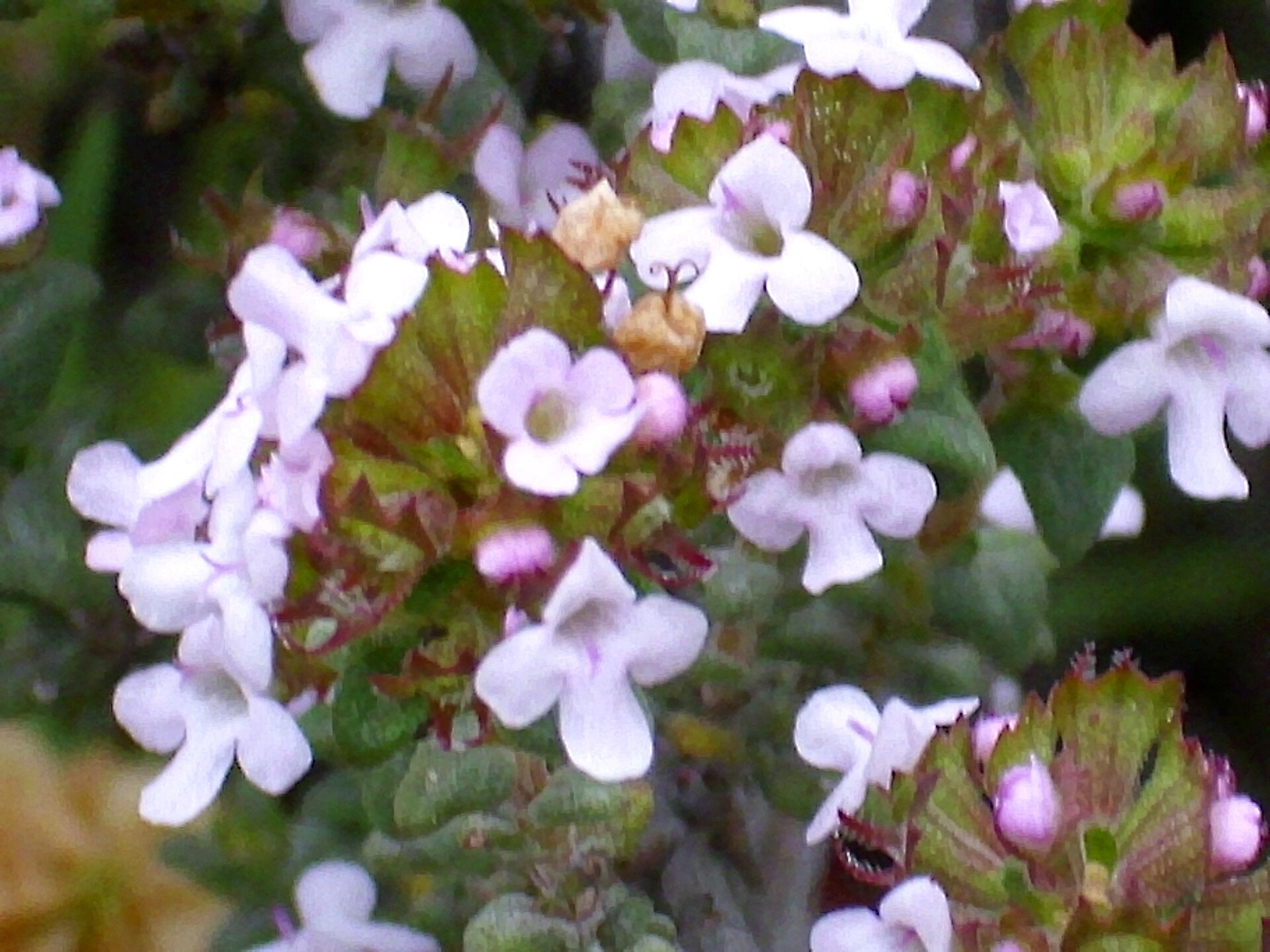
Leaves: tiny, about ¼–½ inch long, linear to oval with pointed tips, dark grayish-green, finely hairy, with edges that roll under. They grow in pairs at right angles to each other [1].
Stems: square in cross-section and hairy, as in other mint-family plants [1].
Flowers: small (about 4–5 mm), tubular, two-lipped, white to pinkish-lavender, in spikes at the stem tips, usually from about May to July [1].
Smell: strongly fragrant, especially at flowering [1].
Dried product: sold as dried, crumbled leaves (and flowers), usually labeled "thyme." European medicinal products specify Thymus vulgaris and/or Thymus zygis[3].
There are many kinds of thyme and many garden varieties (for example, orange- or citrus-scented types) [1]. The EU medicine monographs cover only T. vulgaris and T. zygis[3]. Wild or creeping thyme (Thymus serpyllum) is a different species [11].
Garden thyme has no dangerous look-alikes that we found in reliable sources. Buy it from a store or nursery, or grow it from a labeled plant.
❦
Safety and interactions
Mint-family (Lamiaceae) allergy: don't use medicinal thyme if you are allergic to thyme or related plants [3][4]. Allergic reactions to thyme oil have been reported [8][9].
Stomach upset: stomach problems may occur with thyme medicines [3][4].
Skin irritation from the oil: thyme oil can irritate the skin [8][9]. Never use it undiluted.
Pregnancy and breastfeeding: safety has not been established, so EU regulators don't recommend thyme or thyme oil medicines during pregnancy or breastfeeding [3][8]. We did not find a thyme entry in the NIH LactMed database. Normal use of thyme as a seasoning is a separate matter [11].
Children: most thyme medicines are not recommended under age 12, and some liquid preparations are not recommended under age 4 [3]. Thyme oil is not recommended by mouth or on the skin under age 18. Thyme oil baths are not recommended under age 3 [8].
Hot baths with thyme oil: not for people with large wounds, acute skin disease, high fever, severe infection, serious circulation problems, high blood pressure, or heart failure [8][9].
Medication interactions: none reported in the EU monographs [3][8]. We did not find reliable evidence for specific thyme–drug interactions, so we don't list any. Ask your pharmacist before using concentrated thyme products if you take prescription medicine.
Overdose: no cases reported for thyme herb medicines [3].
Pets: the ASPCA lists common thyme as non-toxic to dogs, cats, and horses [2]. Concentrated essential oils are a different matter. Keep them away from pets and children.
Not medical advice
This page is for general education only. It is not medical advice and doesn't replace a doctor, pharmacist, or other qualified professional. Herbs can cause allergic reactions and interact with medicines. Check with a health professional before using any herb, especially if you are pregnant or breastfeeding, giving it to a child, taking medication, or managing a health condition. Never eat or use a wild plant unless an expert has confirmed what it is. For a suspected poisoning in the U.S., call Poison Help at 1-800-222-1222 [13]. In Canada, call 1-844-POISON-X (1-844-764-7669), or the Centre antipoison du Québec at 1-800-463-5060 if you are in Québec [14].
Kemmerich B, Eberhardt R, Stammer H. Efficacy and tolerability of a fluid extract combination of thyme herb and ivy leaves and matched placebo in adults suffering from acute bronchitis with productive cough. Arzneimittelforschung. 2006. https://pubmed.ncbi.nlm.nih.gov/17063641/
Kemmerich B. Evaluation of efficacy and tolerability of a fixed combination of dry extracts of thyme herb and primrose root in adults suffering from acute bronchitis with productive cough. Arzneimittelforschung. 2007. https://pubmed.ncbi.nlm.nih.gov/17966760/
Wagner L, Cramer H, Klose P, et al. Herbal medicine for cough: a systematic review and meta-analysis. Forsch Komplementmed. 2015. https://pubmed.ncbi.nlm.nih.gov/26840418/
Kowalczyk A, Przychodna M, Sopata S, et al. Thymol and thyme essential oil: new insights into selected therapeutic applications. Molecules. 2020. https://pubmed.ncbi.nlm.nih.gov/32917001/