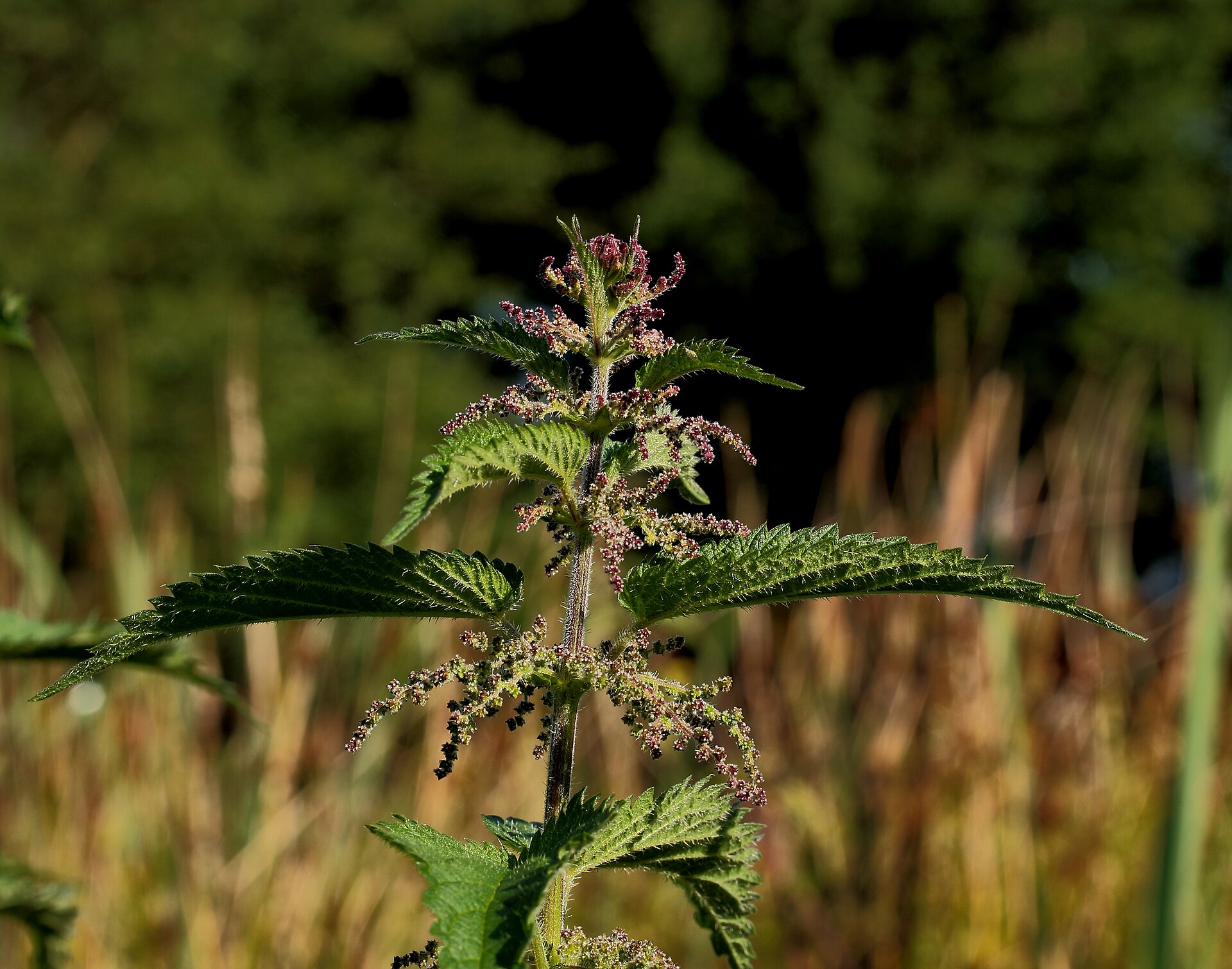
Stinging nettle is a tall, leafy perennial covered in tiny stinging hairs. Brush against it and you'll feel an intense burning and itching that usually fades within minutes [1]. It grows in moist, rich soil along streams, in meadows and ditches, in woodland clearings, and in disturbed areas, and it spreads by underground stems into dense patches [1]. It's found throughout the United States and parts of Canada [2]. NC State Extension lists western North America as part of its native range, along with Europe, Asia, and Africa [1].
Once cooked, young nettle shoots lose their sting and can be eaten as a vegetable [1]. Nettles are considered nourishing plants [2]. Nettle leaf, herb, and root also have long traditional use, and European regulators accept them for minor joint pain, minor urinary complaints, and urinary symptoms of an enlarged prostate. That acceptance is based on traditional use only [3][4][5]. The clinical research is limited and of mixed quality [2].
Quick facts
Specimen · Urticaceae
Botanical name
Urtica dioica L.
Family
Urticaceae (nettle family)
Other names
stinging nettle, common nettle, nettle
❦
Names
Common names: stinging nettle, common nettle, nettle [1][2].
Botanical name:Urtica dioica L. [3]. A smaller relative, Urtica urens (dwarf or annual nettle), is so similar that European regulators and Drugs.com treat the two together [2][3].
This section describes how people have used stinging nettle historically. It does not show that these uses work. See the next section for the evidence.
Food: the tender tips of young nettles have long been cooked as a potherb. Nettles were also used to treat scurvy [2].
"Water pill" and urinary health: nettle has been used as a diuretic [1][2]. The root has been used for an enlarged prostate (benign prostatic hyperplasia, or BPH) and other urinary disorders [1]. European regulators accept nettle leaf and herb as a traditional way to increase urine for minor urinary complaints [3][4]. They also accept the root for urinary symptoms of BPH, once a doctor has ruled out serious conditions [5].
Joints: leaf tea has been used for arthritis and gout. Some people deliberately sting painful joints with fresh leaves, a practice called "urtication" [1]. European regulators accept nettle leaf and herb as a traditional remedy for minor joint pain [3][4].
Allergies and breathing: leaf tea has been used for hay fever [1], and nettle has been used for asthma and as an expectorant [2].
Skin and hair: nettle juice has been put on the scalp to encourage hair growth, and it has been used for dandruff and greasy hair [1][2]. European regulators accept nettle herb as a traditional remedy for oily (seborrheic) skin conditions [4].
After childbirth: nettle has been taken as a postpartum "tonic" for anemia and to increase breast milk [6].
Other uses: diabetes [1], and the foliage has been used as a textile dye [1].
❦
What the evidence says
Bottom line: limited and mixed. There are some placebo-controlled trials, mostly small. Results vary, and few trials are high quality [2].
Use
What was found
Strength
Enlarged prostate (BPH) symptoms
Some placebo-controlled trials, with 100, 246, and 558 participants, found improved prostate symptom scores. Not all found better urine flow, and most nettle trials were open-label [2]. In the largest, 81% on nettle reported improvement versus 16% on placebo. Those authors said the results needed confirming [7]. The American Urological Association's 2021 guideline couldn't recommend nettle or other supplements because of variable results and study quality [2].
Mixed; guideline doesn't recommend
Hay fever (allergic rhinitis)
In a 1990 trial, 69 of 98 people completed a week of freeze-dried nettle leaf or placebo. Nettle rated higher in overall assessments but only slightly better in daily symptom diaries [8].
One small, old trial
Joint pain (nettle sting)
In a crossover trial of 27 people with base-of-thumb arthritis, a week of stinging the area with fresh nettle reduced pain and disability more than a non-stinging placebo leaf [9]. A 42-person knee-pain pilot study showed similar pain changes in the nettle and placebo groups. It was designed to test feasibility, not effectiveness [10].
Very limited
Type 2 diabetes
A 2020 meta-analysis of 8 trials (401 people) found nettle lowered fasting blood sugar, but not long-term blood sugar (HbA1c) or insulin. The results varied widely between studies [11].
What we can't say: that nettle reliably treats an enlarged prostate or replaces medical care for urinary symptoms, that it treats allergies or diabetes, or that it cures hair loss, eczema, or cancer [2][5]. Claims about diabetes, cancer, eczema, rheumatism, hair loss, and aging "have not been substantiated" [2].
❦
How it’s used / prepared
This is general, traditional information, not a recommendation or a dose for you. Talk with a health professional before using nettle for a health purpose.
Parts used: the young shoots and leaves as food; the leaf, the above-ground herb, and the root as medicine [1][3][4][5].
As food: NC State Extension says to soak young shoots in warm water to clean them, handle them with kitchen tongs, and boil them in salted water for five minutes. "The stinging quality disappears after cooking." Serve them as a vegetable or in soups [1].
Tea: the EU traditional-use monographs describe herbal teas made from the dried leaf or herb [3][4] and from the dried root [5].
Extracts and capsules: the clinical trials used specific freeze-dried leaf or root extracts [2]. Commercial products aren't standardized [2].
Topical "urtication": stinging a painful joint with fresh leaves is a traditional practice tested in small trials [1][9]. It deliberately causes stinging and hives [2].
Harvesting: wear gloves. Related wood nettle causes painful contact dermatitis, and NC State recommends gloves for handling it [12]. Avoid roadsides and other places that may be contaminated with herbicides, pesticides, or industrial runoff [13].
When to stop and get help: EU guidance says to see a doctor if joint pain comes with swelling, redness, or fever, or if urinary symptoms worsen or come with fever, painful urination, cramps, or blood in the urine [3][4][5]. The root should only be used for prostate symptoms after a doctor has ruled out serious conditions [5].
❦
How to identify
Stinging nettle is easy to recognize once you know it, but several other plants are called "nettles." Check every feature below.
Stinging hairs: leaves and stems carry hairs that cause intense burning and itching on contact [1].
Leaves:opposite (in pairs), egg-shaped with a heart-shaped base and a pointed tip, saw-toothed edges, and 1–6 inches long [1]. Drugs.com describes them as dark green [2].
Stems: wiry, green, and fairly square, often with stinging hairs [1].
Flowers: tiny green or whitish flowers in dense clusters where the leaves meet the stem and at the stem tips [1], from about June to September [2].
Height: NC State Extension lists 3–9 feet [1]. Drugs.com says up to about 1 meter (3 feet) [2].
Habitat: moist, rich soil along streams, meadows, ditches, mountain slopes, woodland clearings, and disturbed ground. It forms dense colonies [1].
Season: young shoots are the part eaten [1]. NC State advises collecting the related wood nettle only in spring [12].
❦
Look-alikes to avoid
When in doubt, don't.
If any feature doesn't match, or you can't check all of them, leave the plant alone.
There are no dangerous true look-alikes in our verified sources. NC State Extension lists several plants that are often confused with stinging nettle, including wood nettle and false nettle [1]. One poisonous plant shares the "nettle" name.
Wood nettle (Laportea canadensis): also stings
A native nettle of rich, shady woods and river bottomlands, 2–4 feet tall [12].
How it differs: its leaves are alternate (one per joint) rather than in pairs, and large: about 6 inches long and 4 inches wide, with coarse teeth [12].
It stings too. The burning usually fades within an hour. Its young shoots are also eaten after cooking [12].
False nettle (Boehmeria cylindrica): no sting
A native plant of moist, shady woods, swamps, and wet meadows. It looks like a nettle but has no stinging hairs[15].
How it differs: its tiny greenish flowers grow in slender spikes from the leaf joints [15].
Purple dead-nettle (Lamium purpureum): no sting, mint family
A low lawn weed whose name comes from its nettle-like leaves. It doesn't sting, which is why it's called "dead" [16].
How it differs: it's low-growing (up to 2½ feet, usually shorter), with crowded, heart-shaped leaves that are often purple-tinged near the top, and bright reddish-purple, two-lipped flowers[16].
Carolina horse nettle (Solanum carolinense): poisonous, and not a nettle
Despite the name, it's in the nightshade family [17].
How it differs: it has sharp prickles (not fine stinging hairs) on its stems and leaves, star-shaped white to light violet flowers with yellow centers, and small green berries like tiny tomatoes [17].
All parts are poisonous. Symptoms can include nausea, vomiting, drowsiness, and breathing problems, and poisoning may be fatal [17].
The sting: contact causes acute hives (urticaria) from histamine, serotonin, and choline released by the hairs. It usually goes away on its own. Antihistamines and steroid creams may help [2]. Some reactions last longer, and a newborn developed widespread hives after contact with nettle [2]. NC State Extension lists stinging nettle as a problem plant for children [1].
Side effects when taken by mouth: usually mild stomach upset (nausea, vomiting, diarrhea) and skin reactions such as itching, rash, or hives [3][4]. The root can also cause heartburn, fullness, and gas [5].
Who should avoid it: EU guidance says not to use nettle leaf if you've been told to limit fluids, for example because of severe heart or kidney disease [3][4].
Blood sugar: there's a case report of low blood sugar linked to a nettle product [2], and a meta-analysis found nettle lowered fasting blood sugar [11]. If you take diabetes medicine, talk to your doctor before using nettle.
Medication interactions: EU regulators found none reported [3][4][5]. Drugs.com says none are well documented. Some lab and animal studies hint at effects on blood platelets and on drug-processing liver enzymes, but the results are inconsistent and not shown in people [2].
Hormone-related reports: cases of breast enlargement in men (gynecomastia) and nipple discharge (galactorrhea) have been linked to nettle tea [2].
Pregnancy: Drugs.com lists nettle preparations as contraindicated in pregnancy because of effects on hormone metabolism [2]. EU guidance does not recommend nettle leaf or herb in pregnancy [3][4].
Breastfeeding: sources differ. LactMed says nettle is generally well tolerated by adults. It advises against putting nettle on the breast, because one mother's use on her nipple gave her baby a rash [6]. Drugs.com lists it as contraindicated while breastfeeding [2], and EU guidance does not recommend it [3][4]. Talk with your health care provider.
Children: Drugs.com says nettle preparations shouldn't be used under age 12 [2]. EU guidance does not recommend nettle leaf medicines under 12, and some nettle herb preparations aren't recommended under 18 [3][4].
Prostate symptoms: urinary symptoms can have serious causes. The EU root monograph says to use it only after a doctor has ruled these out [5].
Not medical advice
This page is for general education only. It is not medical advice and doesn't replace a doctor, pharmacist, or other qualified professional. Herbs can cause allergic reactions and interact with medicines. Check with a health professional before using any herb, especially if you are pregnant or breastfeeding, giving it to a child, taking medication, or managing a health condition. Never eat or use a wild plant unless an expert has confirmed what it is. For a suspected poisoning in the U.S., call Poison Help at 1-800-222-1222 [14]. In Canada, call 1-844-POISON-X (1-844-764-7669), or the Centre antipoison du Québec at 1-800-463-5060 if you are in Québec [18].
Safarinejad MR. Urtica dioica for treatment of benign prostatic hyperplasia: a prospective, randomized, double-blind, placebo-controlled, crossover study. J Herb Pharmacother. 2005. https://pubmed.ncbi.nlm.nih.gov/16635963/
Mittman P. Randomized, double-blind study of freeze-dried Urtica dioica in the treatment of allergic rhinitis. Planta Med. 1990. https://pubmed.ncbi.nlm.nih.gov/2192379/
Randall C, Randall H, Dobbs F, et al. Randomized controlled trial of nettle sting for treatment of base-of-thumb pain. J R Soc Med. 2000. https://pubmed.ncbi.nlm.nih.gov/10911825/
Randall C, Dickens A, White A, et al. Nettle sting for chronic knee pain: a randomised controlled pilot study. Complement Ther Med. 2008. https://pubmed.ncbi.nlm.nih.gov/18514907/
Ziaei R, Foshati S, Hadi A, et al. The effect of nettle (Urtica dioica) supplementation on the glycemic control of patients with type 2 diabetes mellitus: a systematic review and meta-analysis. Phytother Res. 2020. https://pubmed.ncbi.nlm.nih.gov/31802554/